Impossible Dream: The Original Universally Accessible Catamaran
Mike Browne built the UK outdoor clothing chain Snow & Rock before a skiing accident around 1997 left him paraplegic. Rather than give up the active life he’d built, he spent two and a half years turning a question into a boat: could a catamaran be built that a wheelchair user could sail across oceans, entirely on their own?
Working with naval architect Nic Bailey, Darren Newton’s company Multimarine, and a build team led by Simon Baker — the same Cornwall operation now known as the Multihull Centre — Browne launched the 60-foot carbon-fiber catamaran at the Southampton Boat Show in 2002. Paralympic sailor Andy Cassell did the naming honors. He called her Impossible Dream.
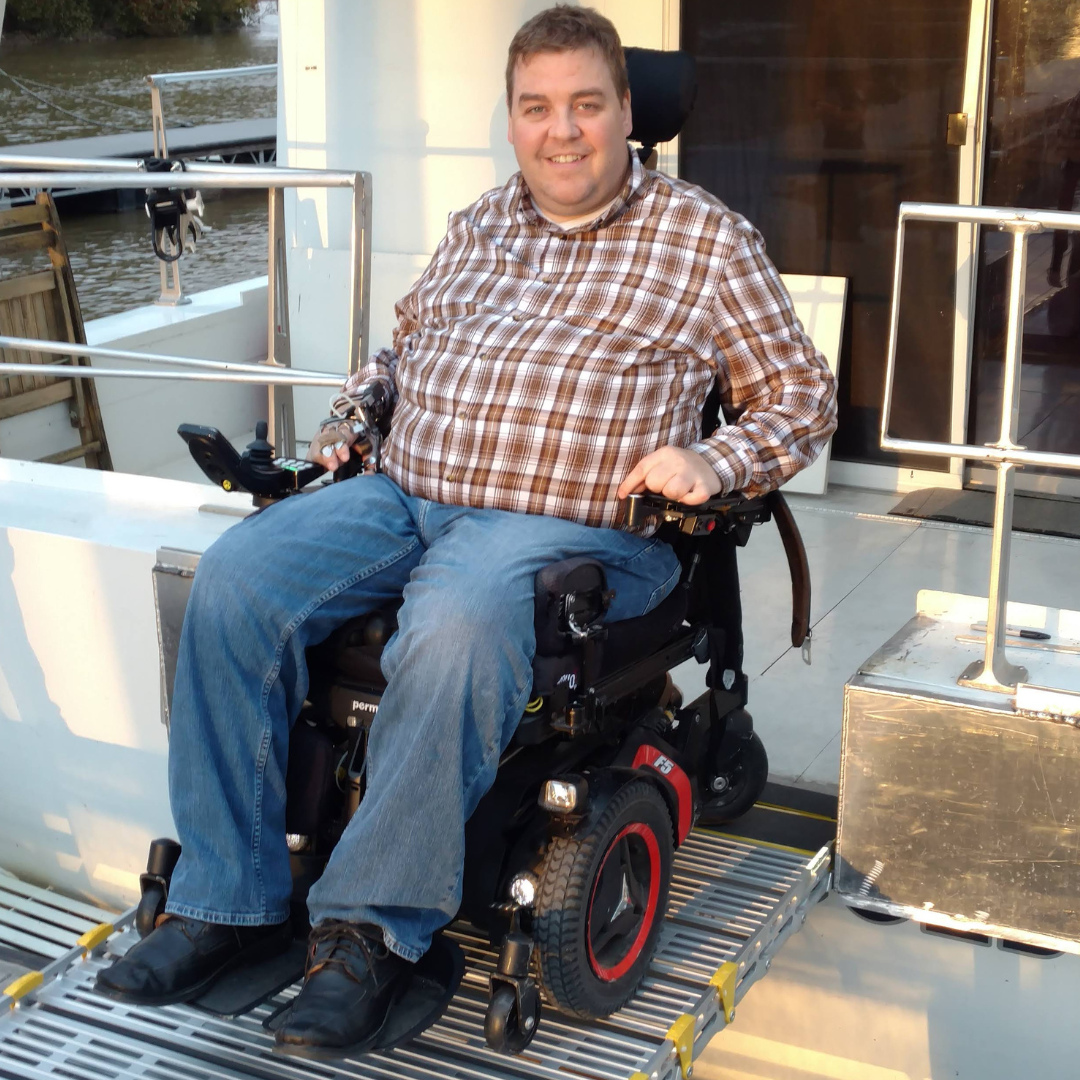
Every system was built around being operated from a wheelchair, or from one of two helm chairs that glide port-to-starboard along a curved carbon track. A single continuous deck level runs the length of the boat, ringed by a grabrail. Push-button hydraulics handle sail trim and steering. Three hydraulic lifts move people around the vertical parts of the boat: one from the dock up onto the deck, and one on each side of the main cabin down into the hulls, where the four cabins and two bathrooms are.
Browne sailed her across the Atlantic and through the Mediterranean for roughly a decade. In 2010, while still under his ownership, quadriplegic sailor Geoff Holtz used Impossible Dream to become the first quadriplegic to sail across the Atlantic solo, accompanied only by a personal care assistant.
A design built for one man, and what that revealed
Impossible Dream is genuinely groundbreaking design — but it was built around Mike Browne’s own body and his own manual wheelchair, and that specificity has real limits. The lifts down to the cabins and bathrooms were never engineered to carry the weight of a power wheelchair. Anyone using one has to transfer into a manual chair just to get below deck. It’s a clear, honest example of a lesson worth sitting with: even thoughtful, purpose-built accessible design, if it’s built around one person’s specific needs rather than a genuine range of bodies and equipment, can leave real gaps for the very community it’s meant to serve. Design for the range, not just the individual in front of you, or the gap shows up later — often for someone who needs it just as much.
After about ten years, Browne began looking for an organization to carry the boat’s mission forward. Around 2014, Deborah Mellen — a paraplegic businesswoman who’d discovered sailing through Shake-A-Leg Miami’s adaptive program — traveled to England with Shake-A-Leg founder Harry Horgan (himself paralyzed in a car accident) to see the boat, and bought her on the spot. Together they founded Impossible Dream Inc., a 501©(3), and shipped the catamaran across the Atlantic to her new home at Shake-A-Leg Miami in Coconut Grove.
Life since Miami
Since 2015, Impossible Dream has spent summers touring the East Coast from Florida to Maine, taking wheelchair users, wounded veterans, at-risk youth, and their families sailing — free of charge, true to the boat’s original “barrier-free, including cost” ethos. She’s taken roughly a thousand people sailing in a single summer alone, partners with major rehabilitation centers including Kennedy Krieger, Magee, Mount Sinai, and Spaulding, and in 2016 raced Key West to Cuba and back in the Conch Republic Cup with three wheelchair users aboard.
Mellen and Shake-A-Leg have long talked about building an even larger, roughly 80-foot successor — one built explicitly to fix the power-wheelchair gap in the current boat, and to let larger-chair users stay aboard overnight. As of the most recent reporting, that remains a future goal rather than a funded project.
*Sources: Impossible Dream Inc. (theimpossibledream.org), New Mobility, Yachting World, Yachting Magazine, Cruising World, WindCheck Magazine, and local press coverage of the boat's East Coast tour stops (Baltimore Sun, Shelter Island Reporter, Laconia Daily Sun, and others).*